Li-Fi, or Light Fidelity, is an innovative wireless communication technology that uses visible light to transmit data. Unlike traditional Wi-Fi, which relies on radio waves, Li-Fi leverages LED light bulbs to send high-speed internet signals. This line-of-sight communication not only provides faster data transfer rates but also offers enhanced security. Understanding the cryptography and encryption difference is key to seeing how Li-Fi secures these signals at a fundamental level.
With the growing number of IoT devices and smart systems, the demand for secure and reliable indoor networks is higher than ever. Li-Fi is emerging as a promising solution for homes, offices, hospitals, and industrial facilities, offering both speed and safety.
How Li-Fi Ensures Secure Indoor Wireless Networks
One of the most significant advantages of Li-Fi is its inherent security features. Since light cannot penetrate walls, Li-Fi signals remain confined within a room, drastically reducing the risk of unauthorized access. Unlike Wi-Fi, which can extend beyond physical boundaries, Li-Fi ensures that only devices within the coverage area can access the network.
Additional security benefits include:
- Resistance to electromagnetic interference: Li-Fi does not interfere with sensitive equipment, making it ideal for hospitals and industrial environments.
- Encryption support: Li-Fi networks can use standard protocols. However, it is vital to understand authentication vs encryption to ensure that only verified users can access the light-based data stream.
- Low hacking risk: The physical confinement of light signals makes remote hacking nearly impossible.
Applications of Li-Fi in Smart Homes
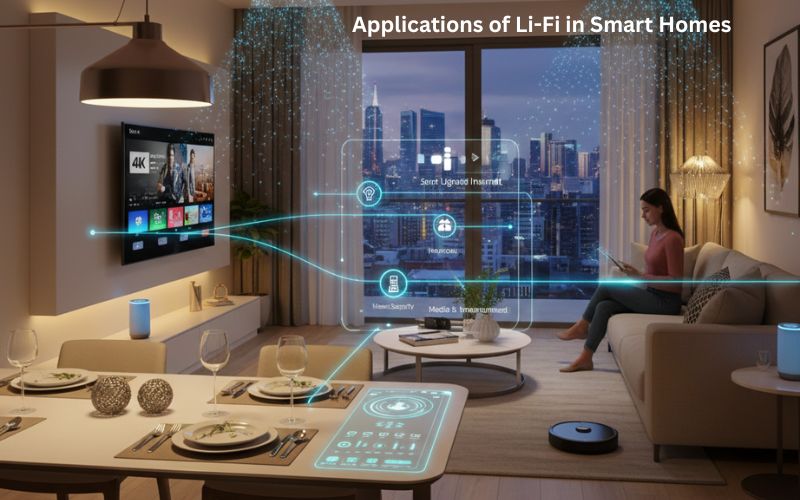
Li-Fi is revolutionizing smart home technology. By integrating LED lighting with data transmission, homeowners can enjoy fast and secure internet connectivity throughout the house.
Key advantages include:
- Secure home networks: Sensitive data, such as security camera feeds and personal devices, remain protected. This is a significant step up from standard apps; for instance, many users look for ways to remove WhatsApp end-to-end encryption, but Li-Fi provides physical-layer security that doesn’t compromise privacy.
- Energy efficiency: LED bulbs used for Li-Fi consume less power compared to traditional Wi-Fi routers.
- IoT integration: Li-Fi can connect multiple smart devices, including thermostats and smart locks. This is particularly relevant when discussing the broader pros and cons in technology as we move toward hyper-connected homes.
For homeowners concerned about both speed and safety, Li-Fi offers a practical and future-proof solution.
Li-Fi in Hospitals and Healthcare Facilities
Hospitals require highly secure and interference-free networks to manage patient data, medical equipment, and real-time communication. Li-Fi provides a unique solution to these challenges.
Benefits in healthcare include:
- Secure transmission of patient information: Li-Fi reduces the risk of sensitive data leaks.
- Interference-free communication: Unlike Wi-Fi, Li-Fi does not affect critical medical devices.
- Faster communication between departments: Real-time updates can be shared with minimal latency, improving patient care.
Some hospitals are already running pilot programs using Li-Fi for operating rooms and patient monitoring, demonstrating its effectiveness and reliability.
Li-Fi for Businesses and Offices
Modern offices demand fast and secure wireless networks to support high data traffic and multiple connected devices. Li-Fi can enhance workplace productivity by providing:
- Secure corporate communication: Confidential business information remains protected within the office.
- High-speed data transfer: Large files, video conferences, and cloud applications run smoothly without interference.
- Seamless IoT integration: Smart lighting, sensors, and office automation systems can communicate efficiently using Li-Fi.
By adopting Li-Fi, organizations can improve network security and efficiency, creating a safer and more productive work environment.
Industrial Applications: Li-Fi for Industry 4.0

In industrial settings, reliable communication is critical for machine-to-machine (M2M) interactions. Li-Fi is highly suited for Industry 4.0, much like how backscatter IoT sensor nodes are being used to create low-power, highly efficient industrial environments.
- High-speed data transfer in factories and warehouses
- Interference-free operations in sensitive equipment areas
- Enhanced safety and efficiency through precise connectivity
Industries implementing Li-Fi can achieve more secure operations while reducing downtime caused by wireless interference.
Li-Fi in Transportation and Public Spaces
Li-Fi technology is not limited to homes and offices. Its applications in transportation and public spaces are growing rapidly:
- Trains and metros: Secure passenger communication, ticketing, and Wi-Fi access confined within the train compartments.
- Aviation: High-speed in-flight connectivity without interference with avionics.
- Crowded environments: Li-Fi can provide secure internet access in libraries, conference centers, and museums where Wi-Fi signals may be congested.
- Smart Cities: Li-Fi is a core component in the rollout of 6G Terahertz applications for smart cities, providing dense, localized data coverage.
By using Li-Fi, these spaces can ensure fast, reliable, and secure indoor networks for both operational and public use.
Challenges and Solutions in Li-Fi Deployment
Despite its advantages, Li-Fi also faces some challenges:
- Line-of-sight limitation: Since Li-Fi requires light to reach the receiving device, obstacles can disrupt connectivity. Solution: Hybrid Li-Fi/Wi-Fi systems.
- Infrastructure costs: Installing Li-Fi-enabled LED lighting can be expensive initially. Solution: Gradual integration with existing lighting systems.
- Device compatibility: Most current mobile phones do not have built-in Li-Fi sensors. While we debate if mobile phones should be allowed in schools, the technology they use is constantly shifting toward these more secure light-based systems.
Addressing these challenges ensures that Li-Fi can be widely adopted without compromising performance or security.
Future of Li-Fi Technology in Indoor Wireless Security
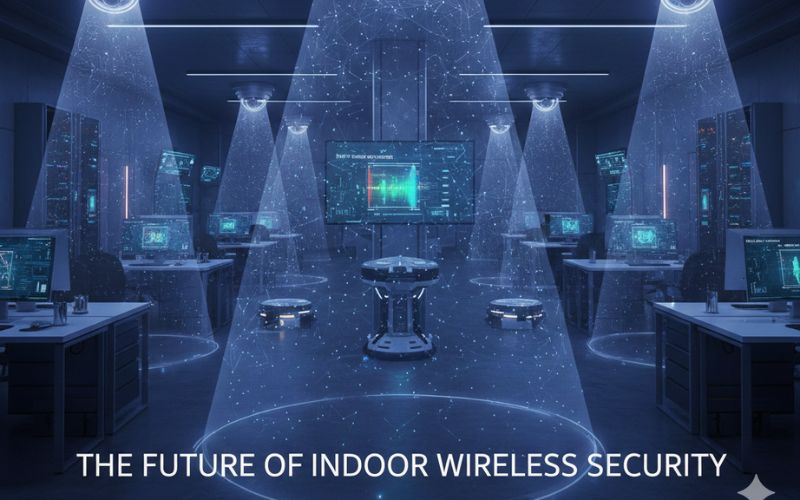
As we look toward the future, Li-Fi will likely work alongside other cutting-edge tech. For example, programmable metasurfaces for wireless connectivity could help solve the line-of-sight issues in rural or complex indoor areas.
- Virtual and augmented reality: Li-Fi can support high-speed data transmission required for immersive experiences.
- Smart cities and IoT expansion: Li-Fi will provide secure and efficient connectivity for homes, offices, hospitals, and public spaces.
- Continued research and innovation: Faster speeds, better coverage, and hybrid network solutions will expand Li-Fi adoption by 2025 and beyond.
As the world increasingly relies on digital communication, Li-Fi offers a secure, high-speed, and energy-efficient alternative to traditional Wi-Fi networks.
Conclusion
Li-Fi technology for secure indoor wireless networks is transforming the way we connect in homes, offices, hospitals, and industries. By providing high-speed, interference-free, and secure communication, Li-Fi addresses the growing need for reliable and protected indoor networks.
With continued adoption and technological advancements, Li-Fi is poised to become an essential part of smart homes, businesses, industrial facilities, and public spaces, ensuring both speed and security in indoor wireless communication.