As global concerns about food contamination, adulteration, and chronic diseases rise, industries are shifting toward faster and more accurate diagnostic methods. Traditional laboratory testing methods are reliable but often slow, costly, and require specialized staff. Electronic noses (e-noses) offer an intelligent and efficient alternative. These devices analyze odor molecules using advanced sensors and artificial intelligence, providing quick and accurate detection. By 2025, e-noses have become essential tools in food production, clinical diagnostics, agriculture, and environmental monitoring due to their non-invasive and real-time capabilities.
Basic Principle of Electronic Noses
Electronic noses operate on the concept of artificial olfaction, mimicking the human sense of smell. They contain a multisensor array that responds to volatile organic compounds (VOCs) emitted from food, human breath, or biological samples. When VOCs interact with these sensors, each sensor produces a distinct electrical pattern. These patterns form an odor “signature,” which is analyzed by machine learning algorithms. The system compares new data to trained models, allowing it to detect spoilage, contamination, freshness levels, or disease-related biomarkers with high precision.
Core Hardware Sensors Used in E-Nose Systems
The effectiveness of an electronic nose depends on the type and quality of sensors installed.
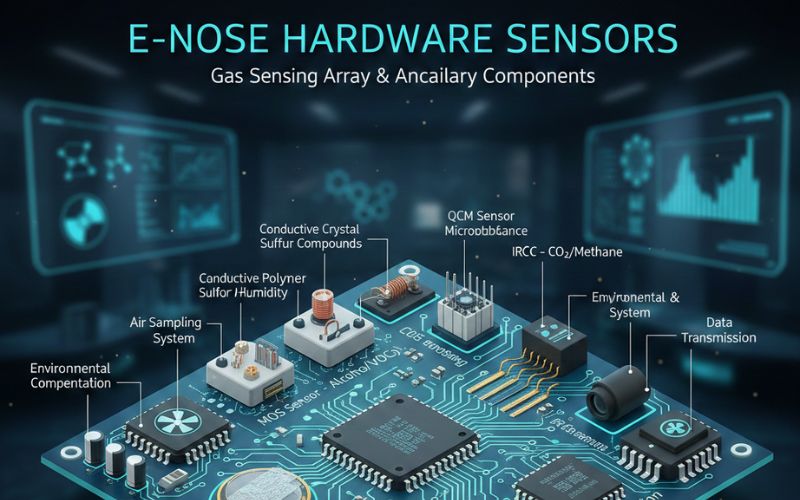
- Metal Oxide Semiconductor (MOS) sensors are ideal for detecting gases associated with food spoilage like ammonia and sulfur compounds.
- Conducting Polymer (CP) sensors respond rapidly to organic vapors, making them useful in flavor and aroma assessment.
- Quartz Crystal Microbalance (QCM) sensors detect minute mass changes, making them suitable for medical VOC analysis.
- Optical and Acoustic Sensors provide stable readings across varying environments.
Together, these sensors form a comprehensive detection system that captures complex odor patterns more accurately than traditional techniques.
Core Software Intelligent Sensory Algorithms & AI Models
The software component of an e-nose is responsible for transforming raw sensor data into meaningful results. Modern e-noses use advanced algorithms such as Support Vector Machines (SVM), Neural Networks, Random Forest, and Principal Component Analysis (PCA). These tools analyze VOC patterns and classify them into categories like “fresh,” “spoiled,” or “contaminated.” Much like how memristor-based neuromorphic chips are revolutionizing edge AI processing, e-nose AI models are pushing intelligence closer to the point of sensing. In health diagnostics, AI algorithms can identify unique disease biomarkers by learning from large breath-analyzer datasets. Deep learning enhances performance further by capturing complex odor relationships that traditional algorithms may miss, resulting in highly accurate predictions.
Applications in Food Quality & Safety Monitoring
Electronic noses provide rapid and reliable insights into food quality, making them highly valuable in the food industry.
- They detect early spoilage in meat, seafood, dairy, and packaged products by sensing VOC changes that occur before visible signs appear.
- Just as choosing healthy food recipes with fresh, high-quality ingredients matters for nutrition, ensuring ingredient freshness through e-nose technology is equally critical at the production l
- E-noses evaluate the freshness of fruits, vegetables, coffee, tea, oils, and spices, helping companies maintain consistent product quality.
- They identify adulteration in products such as milk, honey, and oils, ensuring authenticity.
- During production, e-noses help maintain flavor consistency and verify batch quality.
- Packaging integrity can also be monitored, as e-noses detect leakage or microbial growth inside sealed containers.
This high-speed detection reduces waste, prevents contamination, and enhances consumer safety.
Applications in Human Health Diagnostics
Electronic noses are revolutionizing healthcare with their ability to analyze breath-based VOC biomarkers.
- They detect respiratory diseases like asthma, tuberculosis, pneumonia, and COPD by analyzing breath patterns.
- E-noses are being explored for early detection of cancers, especially lung and breast cancer, through specific VOC signatures.
- They help identify metabolic disorders such as diabetes by detecting elevated acetone levels in exhaled breath — complementing broader daily health and wellness routines that focus on monitoring personal health markers. Kidney and liver disorders also produce distinct VOC patterns measurable by e-noses.
- Kidney and liver disorders also produce distinct VOC patterns measurable by e-noses.
Since these devices are non-invasive, fast, and patient-friendly, they are expected to become common in hospitals, telehealth devices, and home diagnostics.
Combined Technologies (E-Nose + E-Tongue + AI + IoT)
Modern innovations combine e-noses with complementary technologies to boost accuracy.
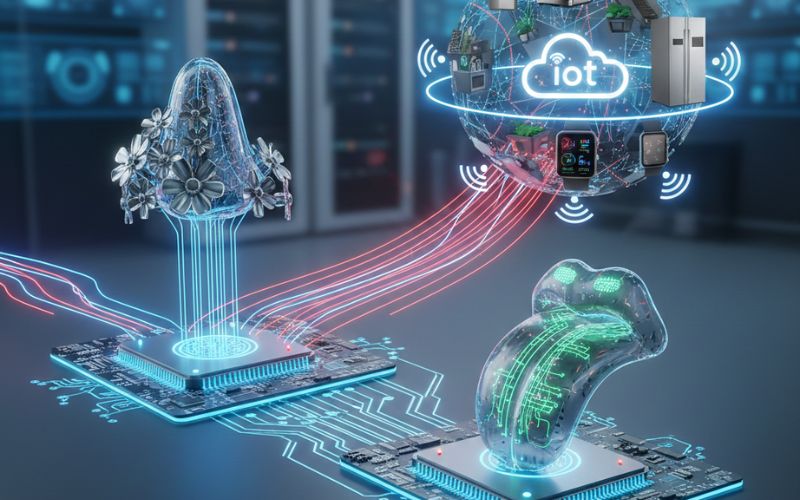
- Electronic tongues (e-tongues) provide taste analysis, enhancing detection in food and beverage industries.
- AI integration allows continuous learning from global odor databases, improving detection consistency.
- IoT connectivity enables real-time monitoring in storage units, medical facilities, and transportation systems.
- Combined e-nose + e-tongue systems can perform complete sensory analysis, providing precise quality control data.
These integrated technologies help industries automate decision-making, reduce errors, and achieve higher efficiency.
Future of Electronic Noses in Health & Food Industries
The futThe future of e-noses is filled with exciting possibilities. Researchers are developing portable and wearable e-noses that monitor breath health continuously through masks or mobile attachments. Smart food packaging embedded with mini e-nose sensors may soon alert consumers if a product is spoiled. In agriculture, e-noses may detect early plant diseases through odor changes in crops.
AI-powered predictive systems will forecast contamination risks before they occur, significantly reducing food waste. This is particularly exciting when paired with sustainable lifestyle choices that aim to reduce environmental impact across the supply chain. In healthcare, e-noses could become essential home diagnostic devices — imagine pairing them with the best health and wellness apps to get real-time metabolic feedback from the comfort of your home. There is also exciting crossover potential with tactile internet applications for remote healthcare, where multiple sensing modalities combine to deliver complete patient monitoring at a distance. Overall, the technology is evolving toward miniaturization, automation, and real-time analysis.
Challenges, Limitations & Current Research Gaps
Despite significant progress, electronic noses still face several limitations.
- Sensor drift reduces accuracy over time, making frequent calibration necessary.
- Environmental changes such as humidity, temperature, and air composition can affect readings.
- There is no universal odor database, making it difficult to standardize results across different e-nose models.
- Medical applications require more clinical testing to confirm the reliability of VOC biomarkers.
- High manufacturing costs for advanced sensor arrays limit widespread adoption.
Researchers are actively working on improving sensor durability, reducing noise interference, and enhancing long-term stability to overcome these challenges.
Conclusion
Electronic noses have emerged as powerful tools for improving food safety and advancing non-invasive health diagnostics. By analyzing VOC patterns using advanced sensors and AI-powered algorithms, these devices detect spoilage, contamination, and disease biomarkers with remarkable accuracy. Their ability to provide real-time results makes them invaluable across industries such as food production, medicine, environmental monitoring, and smart packaging. As part of a larger shift toward smarter technology — alongside innovations like subvocal recognition interfaces and 6G terahertz communications in smart cities — e-noses will play an even greater role in creating safer foods, healthier communities, and smarter diagnostic systems. For those interested in staying on top of these developments, exploring the Tech category on MindScribes is a great starting point.