Primary Keyword: Australia travel planning tips | Secondary Keywords: two-week Australia itinerary, best places to visit in Australia, Australia trip planning guide, first-time Australia travel tips
Planning a two-week trip to Australia sounds exciting until you realize just how massive the country actually is. Australia is roughly the size of the continental United States, and trying to ‘see it all’ in 14 days will leave you exhausted rather than inspired. The key to a great Australia itinerary is smart prioritization — choosing a focused route, understanding regional climates, and building in time to actually experience each destination rather than just check it off a list.
Why Two Weeks Is the Sweet Spot for First-Time Visitors
Many travelers assume two weeks is too short for Australia. In reality, it is enough time to explore two or three regions meaningfully. The mistake most people make is spreading themselves too thin. A well-structured Australia trip planning guide will tell you the same thing: depth beats breadth every time.
For first-time visitors, the most rewarding two-week Australia itinerary typically anchors in either the East Coast (Sydney, Melbourne, and the Great Barrier Reef) or a combination of the East Coast and the Red Centre (Uluru and Alice Springs). Both routes offer a mix of urban culture, natural wonder, and genuine Australian character.
• East Coast Route: Sydney → Brisbane/Gold Coast → Cairns + Great Barrier Reef
• Red Centre Add-On: Fly into Uluru for 2–3 nights, then rejoin the coast
• For adventure travelers: Add the Blue Mountains or Daintree Rainforest to either route
• Budget consideration: Domestic flights save hours of ground time and are often surprisingly affordable when booked early
Best Time to Visit Australia: Seasons Actually Matter Here
One of the most overlooked Australia travel planning tips is timing your visit around the regional seasons, not just a general ‘Australian summer.’ Australia spans multiple climate zones, and the ‘best time’ varies enormously depending on where you plan to go.
If you want to visit both the tropical north (Cairns, Darwin) and the temperate south (Sydney, Melbourne), April through November is generally your safest window. The tropical north’s wet season runs from roughly November to April, which means heavy rainfall, flooding risks, and reduced access to some natural sites.
• Sydney & Melbourne: Pleasant year-round; December–February is summer and busy with domestic tourists
• Great Barrier Reef: Best visibility May to October; avoid the stinger season (Oct–May) if swimming without a stinger suit
• Uluru: April to September for cooler temperatures; avoid January–February when heat is extreme
• Byron Bay & Gold Coast: March–May for fewer crowds and warm water
If you are managing long-haul fatigue before your journey even begins, it helps to read up on Australia travel tips for long-haul flights and jet lag so you land feeling ready to explore rather than wiped out from the journey.
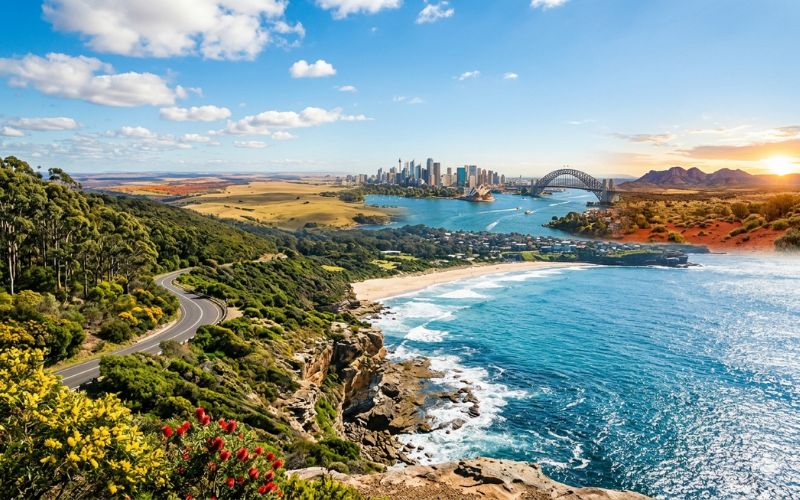
Building Your Two-Week Australia Itinerary: A Practical Framework
A realistic two-week itinerary does not mean 14 different cities. It means 4 to 6 well-chosen stops with enough time to settle in, explore on foot, and discover something that is not in the guidebook. Here is a proven framework that works for most first-time Australia visitors.
Days 1–4: Sydney
Start in Sydney. It is Australia’s most visited city for good reason — the Opera House and Harbour Bridge are genuinely worth seeing, but the real magic is in the neighborhoods. Spend a morning in the Rocks, an afternoon in Bondi (and walk the coastal path to Coogee), and at least one evening in Surry Hills for food. On Day 3, take a day trip to the Blue Mountains — the Three Sisters at sunset is a scene you will not forget.
Days 5–7: Great Barrier Reef / Cairns
Fly from Sydney to Cairns (roughly 3 hours). Allocate at least two full days on or in the reef — one for snorkeling, one for a deeper dive experience or a glass-bottom boat if you are not a swimmer. Cairns itself is a comfortable base with good food and access to the Daintree Rainforest as a half-day trip.
Days 8–10: Melbourne
Fly from Cairns to Melbourne and step into a completely different Australia. Melbourne is all laneway cafes, independent bookshops, and some of the country’s best food. Take the Great Ocean Road on Day 9 — a self-drive that takes you past the Twelve Apostles. Book a car, leave early, and give yourself the full day.
Days 11–14: Uluru & Red Centre
For many travelers, Uluru is the emotional heart of the trip. Fly from Melbourne to Ayers Rock Airport. Spend two nights here at minimum — one sunrise, one sunset, and the Field of Light installation if it is running. On your final day, fly back to Sydney or Melbourne for your international departure.
Budgeting for Australia: What Actually Costs Money
Australia is not a cheap destination, but it is manageable with smart planning. Accommodation and domestic flights are your two biggest variable costs. Booking internal flights at least 6–8 weeks in advance through Jetstar or Virgin Australia can cut costs significantly. Hostels in Australian cities are high quality and social — even travelers who usually avoid them find them worthwhile here.
• Average hostel dorm: AUD $35–55 per night in major cities
• Mid-range hotel (private room): AUD $120–200 per night
• Daily food budget (eating well without excess): AUD $50–80
• Great Barrier Reef day trip: AUD $180–250 depending on operator and dive inclusions
• Domestic flights: AUD $80–200 per leg if booked ahead
Travel cards like the Wise card or a local bank card reduce foreign exchange fees substantially. Avoid airport money exchanges entirely — the rates are poor and you will lose money on every transaction.
Getting Around Australia: Transport Reality Check
Domestic flights are the backbone of any efficient two-week itinerary. Driving between major cities sounds romantic but is genuinely impractical in two weeks — Sydney to Melbourne is nearly 9 hours by car, and Sydney to Cairns is not driveable in any reasonable sense. Reserve the driving for specific day trips: the Great Ocean Road, the Blue Mountains, or a wine region.
Within cities, public transport in Sydney and Melbourne is efficient and tourist-friendly. The Opal Card (Sydney) and Myki Card (Melbourne) handle all public transit with a prepaid contactless system. Cairns is smaller and more walkable, though a rental car helps for reef-town day trips.

Travel Safety and Practical Essentials
Australia is a very safe travel destination by global standards, but there are unique environmental considerations that catch visitors off guard. Sun exposure is genuinely intense — UV levels in Australia are among the highest in the world. SPF 50+ sunscreen, a good hat, and sun-protective clothing are not optional, they are essential.
Wildlife encounters are mostly safe if you respect boundaries. Do not approach kangaroos, wombats, or any wildlife in the wild. In ocean areas, always swim between the flags at patrolled beaches — this is standard practice in Australia and exists for very good reason.
For a more comprehensive understanding of staying safe while traveling through the country, the travel safety tips for tourists visiting Australia guide covers everything from beach safety to sun protection and wildlife awareness in practical, honest terms.
• Always swim between the flags on patrolled beaches
• Apply SPF 50+ sunscreen every two hours when outdoors
• Get comprehensive travel insurance — medical costs can be high for international visitors
• Carry a reusable water bottle; tap water is safe and drinkable throughout Australia
• Download Google Maps offline before heading to any rural or remote area
What to Pack for a Two-Week Australia Trip
Packing for Australia’s varied climates requires layering logic, not volume. You will move between warm coastal climates, cool Melbourne evenings, and potentially the desert heat of Uluru. Lightweight, breathable fabrics that pack small are your best investment — linen and technical fabrics like merino wool work across all three zones.
• Lightweight waterproof jacket: essential for Melbourne and unpredictable coastal weather
• Swim wear and rash guard: for reef swimming, UV protection is critical
• Comfortable walking shoes: you will cover serious daily distances in most cities
• A slightly warmer layer for Blue Mountains or desert nights
• Sun hat and quality sunglasses: non-negotiable in Australian sun
Luggage-wise, a 40-liter carry-on backpack handles two weeks if you pack intentionally. This also eliminates checked baggage fees on domestic flights, which add up quickly across a multi-city itinerary.
Final Thoughts: Make Your Australia Itinerary Work for You
The best Australia travel planning tips are the ones that match the way you actually travel. If you need slow mornings and city walks, Melbourne deserves three full days. If you are a nature-first traveler, the reef and Uluru are worth cutting Melbourne short to extend. This is not a trip where you follow someone else’s itinerary exactly — use a framework and then adjust for what genuinely excites you.
For those who enjoy exploring different parts of the world with the same level of curiosity, the MindScribes Travel section covers a range of destinations and trip planning perspectives worth exploring before you finalize your plans.
Two weeks in Australia is a proper trip. Plan it well, stay curious, and do not try to see everything. The country rewards presence over pace — and the travelers who slow down are almost always the ones who want to come back.