Low-code platforms promised something developers and business teams genuinely wanted: the ability to build functional applications faster, with less hand-written code and fewer bottlenecks. By 2026, analysts project that 75% of all new enterprise applications will be built on low-code or no-code platforms. That statistic alone reflects a seismic shift in how software gets made. Yet beneath the momentum lies a set of real, persistent challenges that teams encounter once the drag-and-drop honeymoon is over.
Chief among them is dynamic event handling the ability to attach responsive, context-aware behaviors to UI elements in a low-code environment. Research analyzing thousands of developer discussions on Stack Overflow found that dynamic event handling in low-code UIs is the single most frequently asked-about customization problem, and simultaneously the one least likely to have a resolved answer. Understanding why this challenge exists, and how to work around it, is what separates teams that succeed with low-code from those that quietly abandon their platforms mid-project.
What Is Low-Code Development? A Quick Grounding
Before diving into the problems, it helps to be clear on what low-code actually means. Low-code development platforms (LCDPs) are environments that let developers and non-developers build applications primarily through visual interfaces, drag-and-drop components, pre-built logic modules, and configuration settings rather than writing every line of code from scratch.
This is meaningfully different from no-code platforms, which aim to eliminate coding altogether. Low-code keeps the option to write custom code open, but abstracts away the routine scaffolding. Popular platforms include OutSystems, Mendix, Microsoft Power Apps, Appian, and Bubble. Understanding how operating system components manage resources underneath these platforms helps put the low-code abstraction layer in proper technical context.
The appeal is straightforward: faster delivery, reduced reliance on specialist developers, and the ability to let business analysts and domain experts participate in building the tools they use. The complications emerge when real-world requirements push against the boundaries of what any visual platform is designed to handle.
The Core Problem: Why Dynamic Event Handling Is So Hard in Low-Code
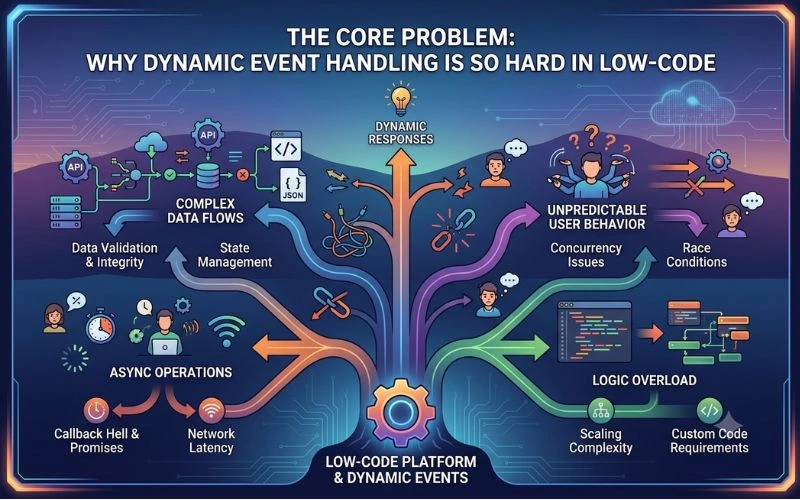
Dynamic event handling refers to the process of programmatically attaching event listeners click handlers, form validation triggers, conditional visibility rules, real-time data updates to UI elements at runtime rather than at design time. In traditional development, this is handled with a few lines of JavaScript or a backend framework’s event system. In a low-code environment, it requires working within the platform’s abstraction model, which may not have been designed with these use cases in mind.
The academic literature on this is clear. An empirical study analyzing around 5,000 Stack Overflow posts about low-code development found that more than 40% of developer questions were about customization, and the topic of dynamic event handling topped the difficulty rankings with a 75.9% rate of questions going unanswered. That number doesn’t reflect a shortage of developers trying; it reflects a genuine gap between what platforms promise and what they can deliver out of the box.
The specific pain points developers run into most frequently include:
• Attaching dynamic events to form fields that are generated at runtime rather than hard-coded at design time
• Triggering behaviors conditionally based on data fetched from external APIs
• Managing event propagation and preventing unintended side effects when components are nested
• Handling asynchronous events in platforms that were built around synchronous, form-submission models
• Debugging event-driven issues when the platform abstracts away the underlying code entirely
Governance Failures and Application Sprawl
Dynamic event handling is a technical challenge. Governance failures are an organizational one but they can cause just as much damage. Organizations that embrace citizen development (letting non-technical staff build their own applications) without appropriate oversight consistently run into what’s called application sprawl: dozens of loosely documented apps built by different people with different conventions, no ownership records, and no maintenance plans.
The scenario plays out in a predictable pattern. A business analyst builds a Power Apps form to handle procurement approvals. It works well and gets used daily. Then that person leaves the company. Nobody else knows how the app is structured, what data connections it uses, or how to modify it without breaking something. The app quietly becomes a single point of failure buried inside critical operations.
Just as civic tech platforms face sustainability challenges when key contributors leave without documentation or handover, low-code applications suffer the same fate when governance is treated as optional rather than foundational. The fix requires organizational discipline, not just technical solutions: version control, documented ownership, mandatory naming conventions, and a platform registry that tracks every application in use.
Technical Debt That Hides Until It Doesn’t
Low-code’s speed advantage is real. The technical debt it can quietly accumulate is also real. The two are connected: because platforms make it so easy to get something working quickly, they also make it easy to skip the structural decisions that keep an application maintainable at scale.
Hidden dependencies are a particularly common manifestation. A low-code application might rely on a connector to a legacy database, a third-party API with undocumented rate limits, or a platform feature that’s flagged as “beta” in the documentation. These dependencies don’t cause problems at launch; they emerge six months later when systems are already embedded into daily operations and the cost of untangling them is significantly higher than it would have been if they’d been addressed up front.
Vendor lock-in compounds this. Low-code platforms typically use proprietary runtimes and store application logic in formats that don’t export cleanly to other environments. Organizations that build deeply on a single platform without open standards support REST APIs, data export in standard formats, and non-proprietary component frameworks find themselves effectively trapped. Migrating away becomes a full rebuild, not a migration.
Questions to evaluate platform flexibility before committing:
• Does the platform support standard REST API integration with existing enterprise systems?
• Can application logic be exported in a readable, editable format?
• Is there an open SDK for custom component development?
• What happens to your applications if the platform vendor is acquired or shuts down?
• How does the platform handle breaking API changes in its own versioning?
Database Integration and Third-Party API Challenges
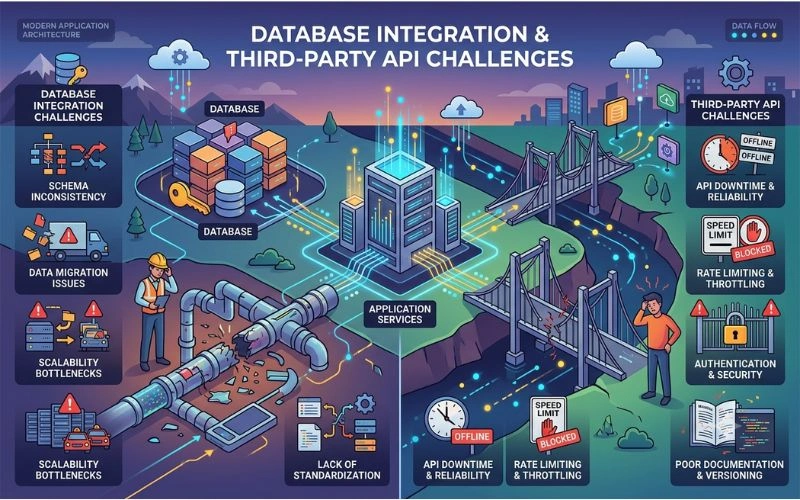
After customization and dynamic event handling, the next most challenging category of low-code problems involves database management and third-party API integration. CRUD operations (create, read, update, delete) are generally well-supported in mature platforms; it’s the edge cases that cause problems.
Schema migrations in particular are a persistent source of friction. When an underlying database structure needs to change, adding a column, modifying a data type, establishing a new relationship between tables, low-code platforms often handle this clumsily. The visual abstraction that makes initial development fast can actually obscure the migration process, making it harder to track what changed and test for regressions.
API integration issues follow a similar pattern. Initial connections to third-party services are typically easy, especially when the platform provides a pre-built connector. The difficulty emerges with advanced use cases: handling pagination in large data responses, managing OAuth token refresh cycles, rate limit management, or dealing with APIs that return inconsistent response formats. These are exactly the scenarios where flexible electronics and IoT systems face analogous integration hurdles the hardware-software interface layer works smoothly in standard configurations and breaks down at the edges.
Security and Compliance: The Issues That Emerge After Launch
Security considerations in low-code development deserve more attention than they typically receive at the planning stage. When applications are developed quickly, often by contributors without security engineering backgrounds, security measures tend to get deprioritized in favor of shipping. The result is that vulnerabilities in authentication flows, data storage, and access control surface later after the application is embedded in production systems.
Developers working inside low-code platforms have limited visibility into the generated code, which means they can’t easily audit it for security issues the way they would with hand-written code. This is particularly concerning in regulated industries where compliance requirements around data handling, audit logging, and access control are non-negotiable. The speed that makes low-code attractive in regulated contexts can actually work against compliance when governance structures aren’t in place from day one.
There is an instructive parallel with how screenless display technologies require careful data handling at the hardware-software boundary: the abstraction that makes a system accessible also reduces direct control over what happens underneath. In both cases, the answer is deliberate security architecture rather than security bolted on after the fact.
Choosing the Right Platform for Your Stack, Team, and Budget
Platform selection is where many low-code projects go wrong before a single component is dragged and dropped. Different platforms are optimized for different use cases, team compositions, and technical environments. The mistake organizations make most often is evaluating platforms based on demos and vendor promises rather than hands-on testing with the actual team members who will use them daily.
The key variables worth assessing before committing:
• Team technical profile: Is your team primarily composed of professional developers, business analysts, or a mix? Platforms like OutSystems and Mendix have steeper learning curves but deeper customization; tools like Power Apps and Appian are more accessible to non-developers
• Existing ecosystem: Organizations already inside the Microsoft stack will find Power Apps integration much smoother than a platform with limited connector support for Azure, SharePoint, or Teams
• Scalability ceiling: Prototyping and internal tools have very different scale requirements than customer-facing applications handling thousands of concurrent users check how the platform’s pricing and architecture change at scale
• Support and community: A platform with active developer forums, third-party training resources, and responsive vendor support is meaningfully less risky than one with sparse documentation
• Exit costs: Evaluate what it would realistically cost to rebuild your applications on a different platform this gives you a realistic picture of the long-term commitment you’re making
The decision process is not unlike the due diligence behind choosing volumetric display technology for a specific immersive tech application: the right tool is the one that matches the actual use case and operational environment, not the one with the most impressive headline feature set.
Practical Workarounds for Dynamic Event Handling Limitations
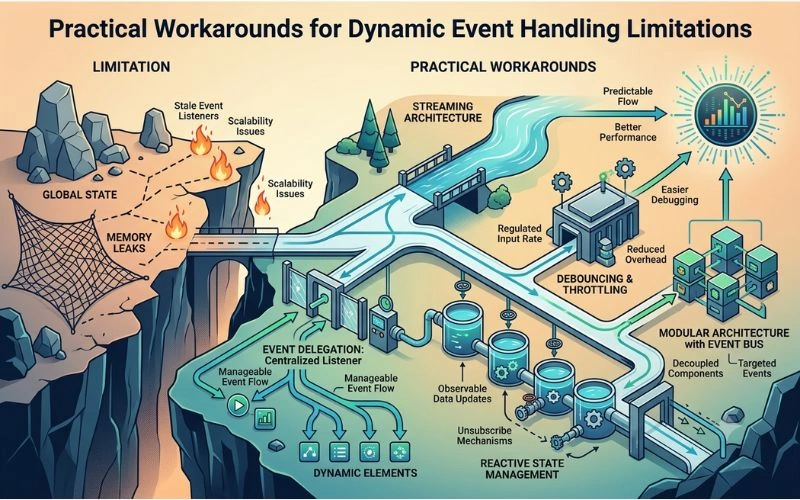
For teams already committed to a low-code platform and running into dynamic event handling walls, the good news is that several practical workarounds exist. The core principle across all of them is the same: use the platform for what it does well, and extend it deliberately where it doesn’t.
Most mature low-code platforms provide a custom code escape hatch, a way to inject JavaScript, Python, or platform-specific scripting into specific components. This is the right tool for dynamic event binding scenarios that the visual interface can’t accommodate. The risk is that it creates maintenance complexity: custom code inside a low-code app becomes a liability if the developer who wrote it leaves, or if a platform update changes the expected behavior. Documentation discipline here is non-negotiable.
Event-driven architecture patterns can also reduce reliance on in-platform dynamic event handling. Rather than trying to handle complex event chains inside the low-code environment, route events through external message queues or webhook systems that the platform consumes as triggers. This keeps the low-code layer handling display and basic interaction, while business logic lives in a more controllable environment.
This kind of hybrid approach is increasingly the norm. Much like how e-textile wearables embed sensors into existing garment structures rather than replacing the garment entirely, hybrid low-code models embed custom logic precisely where it’s needed without replacing the entire platform. The result is more resilient than pure low-code and more efficient than hand-coding everything from scratch.
Testing, CI/CD, and the Maturity Gap
Automated testing and CI/CD (continuous integration and continuous deployment) pipelines represent one of the least mature areas in low-code ecosystems. Traditional development teams have decades of tooling around unit testing, integration testing, regression testing, and deployment automation. Low-code platforms have only recently started to address these needs, and many are still catching up.
The practical consequence is that low-code applications are often tested manually, if they’re tested systematically at all. This creates a fragility that scales poorly: as the application grows and more components interact, manual testing becomes impractical, and regressions get discovered in production rather than before it.
Teams that invest early in what testing infrastructure their platform supports even if it’s limited consistently have fewer crisis moments later. The mindset shift required is similar to overcoming the tendency to delay difficult structural decisions until they become emergencies. Low-code testing debt, like any other form of technical debt, compounds the longer it’s deferred.
The minimum testing foundation for a production low-code application should include:
• Environment separation: development, staging, and production instances that are genuinely isolated from each other
• Data validation testing: automated checks that data flows between integrated systems without corruption or data type mismatches
• Access control testing: verification that permissions work as configured, including edge cases and administrator overrides
• Load testing: a realistic assessment of how the application behaves under expected peak traffic before go-live
Where Low-Code Development Is Heading in 2026 and Beyond
The current trajectory of low-code development is being shaped significantly by AI integration. Platforms are beginning to offer AI-assisted component generation, natural language query interfaces that translate business requirements into application logic, and intelligent debugging tools that can identify the source of event handling failures without requiring the developer to navigate the platform’s visual debugger manually.
Hybrid development models are consolidating as the professional standard. Enterprises that tried to go fully low-code for complex applications have largely settled into a pattern where low-code handles the presentation layer, workflow automation, and standard integrations, while professional developers maintain the custom logic, security architecture, and performance-critical components. This division of labor plays to the genuine strengths of each approach.
For teams thinking about their development approach, the MindScribes Tech section regularly covers the intersection of emerging platforms and practical business technology, a useful reference as the low-code landscape continues to evolve.
The platforms that will win long-term are those that take the hardest problems of dynamic event handling, security by default, testing infrastructure, and governance tooling seriously as first-class features rather than edge cases for advanced users. Until then, the teams that succeed with low-code are the ones who go in with clear eyes about where the limits are, and a plan for what to do when they hit them.
Frequently Asked Questions
What is dynamic event handling in low-code platforms?
Dynamic event handling means attaching responsive behaviors, clicks, form triggers, real-time updates to UI elements at runtime rather than during the design phase. It is the most frequently unresolved customization challenge in low-code development environments today.
Why do low-code platforms struggle with complex customization?
Low-code platforms abstract away underlying code for speed and accessibility. That abstraction limits visibility and control, making advanced customizations like dynamic event binding difficult without escaping into custom code, which reintroduces maintenance complexity.
How can teams reduce vendor lock-in risk with low-code tools?
Choose platforms that support standard REST APIs, allow data export in open formats, and do not rely on proprietary runtimes. Regularly assessing what a migration away would realistically cost that number is your true measure of platform dependency and long-term commitment.
What governance practices should organizations establish for low-code apps?
Establish a platform registry tracking all applications, documented ownership for each app, mandatory naming and versioning conventions, and a review process before deployment. Governance prevents application sprawl and ensures continuity when individual developers or citizen builders leave the organization.
Is low-code development suitable for security-sensitive or regulated industries?
It can be, but requires deliberate security architecture from the start. Developers have limited visibility into generated code, so access control, data handling, and audit logging must be designed intentionally. Rushing deployment without security review creates compliance exposure that surfaces after go-live.